(Not) Making a discount water battery
20/2/2026Heating is surprisingly (to me, not to other people probably) expensive. When I am in the apartment I use 30-50 kr. of heating a day, and I don’t even keep the apartment very warm. It is also very cold right now of course, getting down to -10 degrees celcius when windy, so it kind of makes sense, but is still surprising to me. The 1000+ kr. heating costs every month is actually a substantial part of my expenses. Apartment rent is 2300, the car costs probably 500 kr. a month on average, I spend about 2500 on food and other small consumables/subscriptions and entertainment is probably 2-3000 a month so all in all I live on about 8000 kr. each month. So make that 9000 with heating added.
At the same time, electricity is getting quite cheap at times. The Danish government recently reduced the duty on electricity to the EU minimum of 1 øre per kilowatt/hour (so negligible).
That means that the only substantial add-on to electricity price now is the net tariff, which is a fee that goes to the company maintaining the physical electrical network. The net tariff changes based on the time of day, to incentivize people to use electricity outside the peak hours (which is around dinner). The tariff prices currently look like this:
- 0:00 - 6:00 11 øre/kWh
- 6:00 - 17:00 33 øre/kWh
- 17:00 - 21:00 99 øre/kWh
- 21:00 - 0:00 33 øre/kWh
Without the tariffs, electricity prices right now range from about 0,6 dk. per kW/h in the night to about 1,5 around dinner time, but it is quite variable, getting as low as 0,5 in the night sometimes and up to 2,3 around dinner times on unusual days. Anyways, as you can see the net tariffs are a substantial part of the electricity bill, so if you can spend electricity during the night that is optimal. Of course, you also need to buy your electricity at a variable price. I use Gasel, which adds 6 øre per kWh to the price of electricity, but otherwise has no fees.
Knowing all this, I’ve wondered for a while if it could make sense to heat the apartment using electricity when it is cheap instead of using the remote heat from the radiators, which is the same inscrutable price all day (it is measured in “heating units” which cost a fixed amount of 1,52 dk. right now, but who knows what that covers or how much heat it actually provides in my apartment).
Doing this experiment would require some kind of heating device as well as a way of storing the heat. Luckily for me, the most abundant fluid on the planet, water, is an excellent store of heat, so that is not a problem. Storing electricity is way harder because you need something like a lithium battery, but heat is easy (as long as you don’t care too much about the heat loss to the surroundings, but the heat warming up the surroundings is the point of this experiment, so that is fine). So the only thing I needed to find was a heat source. As I would be heating water, an electric kettle seemed the most convenient, and those luckily come very cheap. In fact, I found an electric kettle randomly when I was shopping at Netto for only 40 kr. (!!!), which is what prompted me to start this experiment, as it is practically free. It is important that it is cheap, because I don’t know if any of this makes any practical sense yet. Maybe the heat radiates off too quickly or the apartment becomes too humid or something. We’ll see.
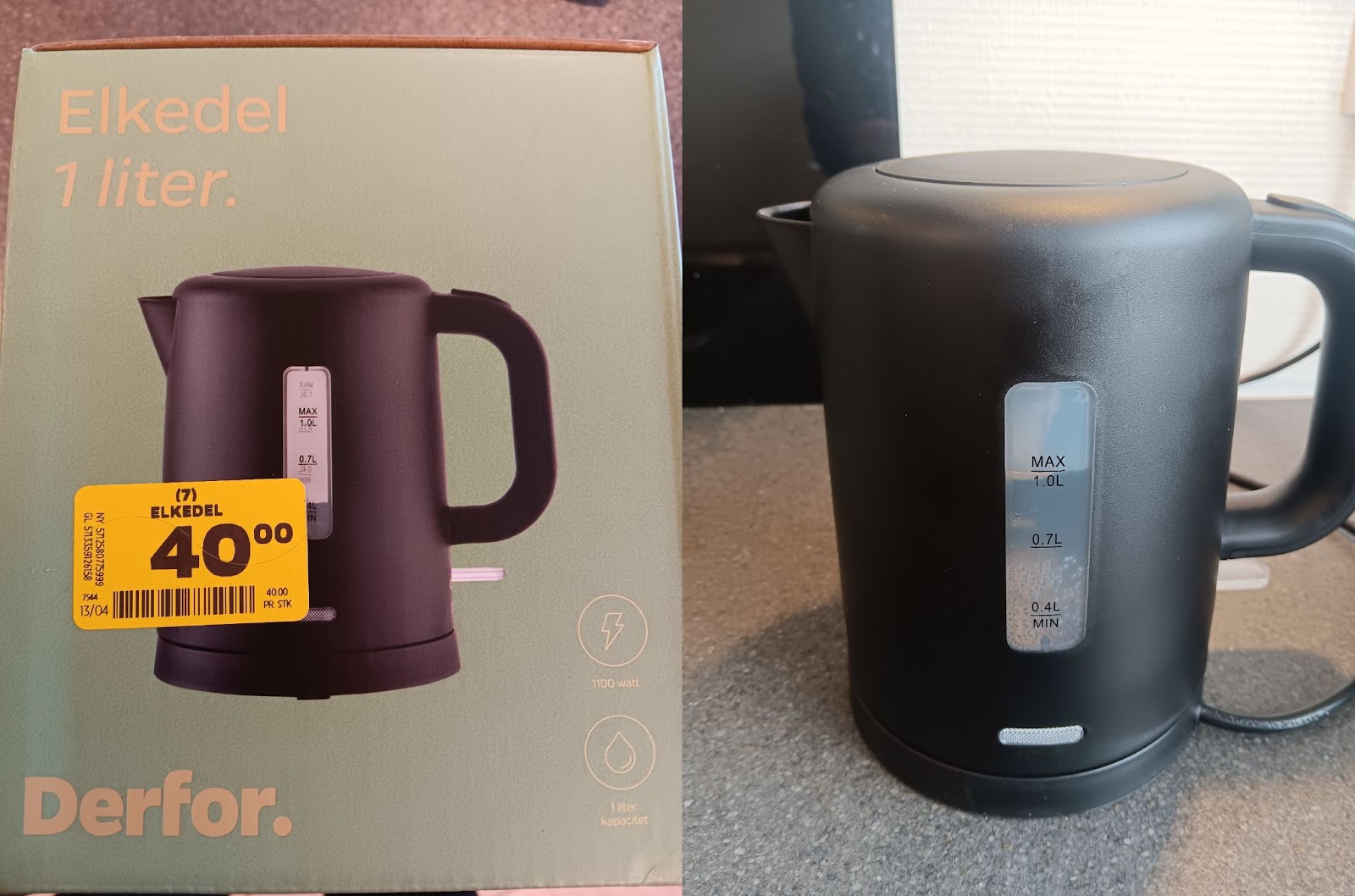
Now, at 1100 watt this is quite a low-powered electric kettle (my main kettle is 2000 watt, and even that is not good), but I don’t really care how fast it heats the water, as I plan to have it on for hours at a time heating a large amount of water.
Before we go further, let’s make a little test. The specific heat capacity of water is 4184 joules per kilogram per degree, meaning that it requires 4184 joules to heat one kilogram of water (which is one liter) one degree. The kettle is 1100 watt, meaning that it delivers 1100 joules per second of energy to the water. In theory it should then take 4184/1100=3,8 seconds to warm one liter of water one degree. The capacity of the kettle is one liter and the normal temperature of water in my apartment is 18 degrees celsius so to reach boiling temperature in theory it should take 3,8*82=311 seconds (5 minutes and 11 seconds). In practice, however, some of the energy will not enter the water but bleed off into the surroundings. Let’s see how it does…
I am back. It took 7 minutes and 2 seconds (422 seconds), which means that (1 - (311/422))*100= 26,3 percent of the energy escaped into the surroundings
(assuming that it really is 1100 watt, which is not certain. Unfortunately I don’t own an electric measurer, so I can’t be sure). That is pretty bad, but you can’t expect much from a 40 kroner kettle.
Anyway, I don’t really care about the heat loss as the point is to lose heat to the surroundings. So I continue to the step where a large amount of water should be in contact with the heating surface. The water that the kettle can contain is not enough, it would boil off too fast.
This is where my ambition and motivation falls short. I own a bunch of 31 liter hard plastic containers bought in Ikea, which is the only candidate for holding the required amount of water I have in the apartment. The heating surface should be in contact with the water in this container, BUT the bottom of the kettle where the electric components are cannot be in contact with the water. I thought about this for a few days but I couldn’t come up with a solution that didn’t require more effort than I was willing to spend. I don’t trust in my ability to cut a hole in the container and make it watertight, and making some other kind of watertight container is too much effort. I tried to cut a hole for the wire in a plastic bag and use elastic bands to hold it tight to the body of the kettle, but I couldn’t make it tight enough to keep the water out.
So in the end I just said fuck it, gaffa-taped the top and bottom together, and submerged it in the water. Obviously, my dream of a stable water heat battery was dead at this point, now I just wanted to see if / how long the kettle could survive contact with the water while heating. Which was surprisingly long. I kind of expected it to die instantly, but it survived for about two days, where it kept the water warm for around an hour before it would turn off via its boiling mechanism thing, after which I would check it out and turn it on again. Very carefully.
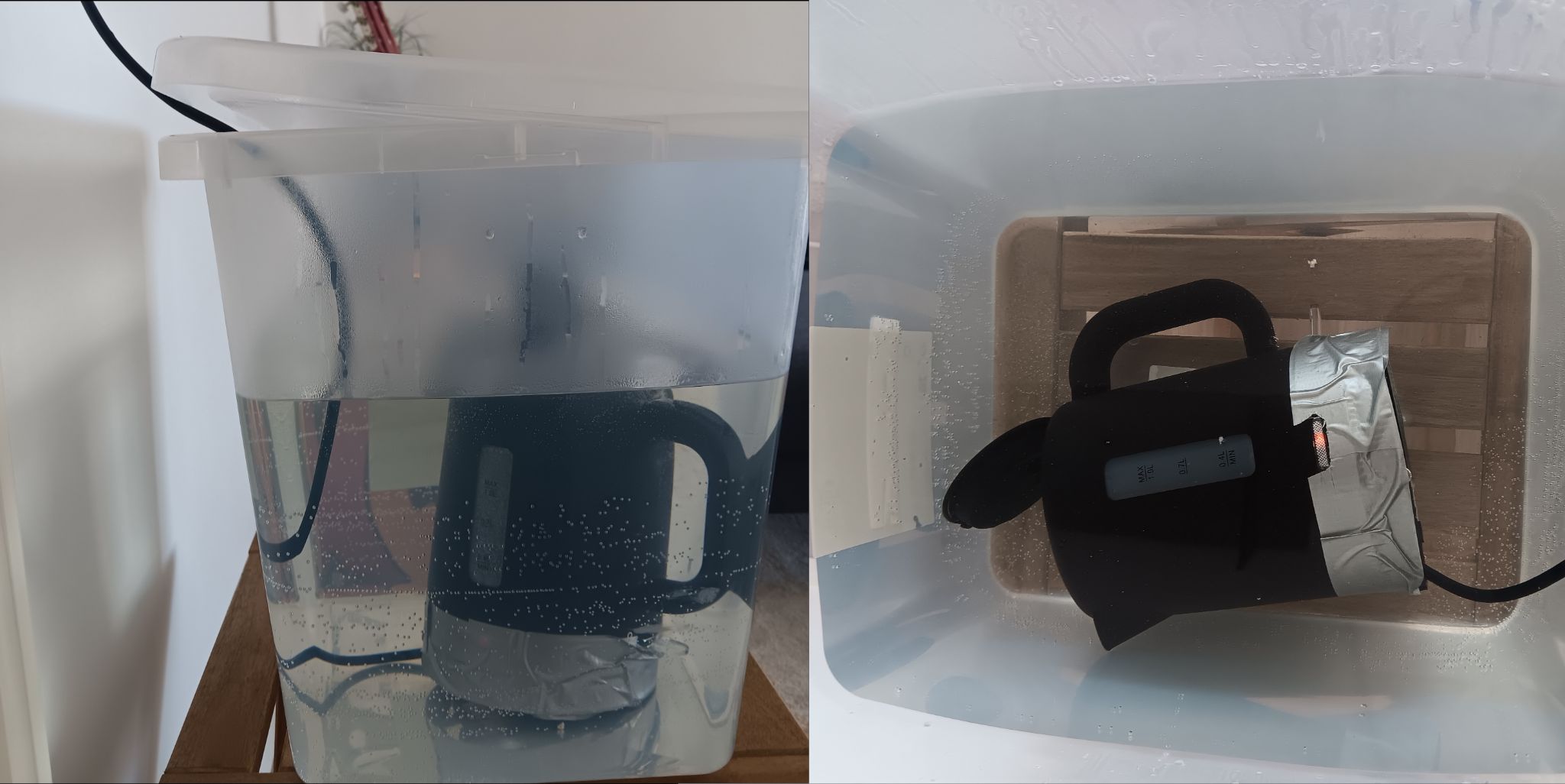
Around the fifth time I did this, there was a crackling sound and persistent bubbles coming from the base of the kettle, and the water filled with copper colored particles, which I suspect was the alloy that gradually melted off. It would not turn on anymore hereafter. I suspect water got into the conjoinment between the top and bottom halves of the kettle, and got so hot it melted the alloy. So is that.
At this point I am a little relieved that it is dead, since this experiment has proven to be a complete failure, although I learned a bunch about heat capacity et cetera, so not completely wasted time. I feel bad about having contributed e-waste to the world, but I guess you can’t learn about electronics without destroying some stuff.
For my next experiment I bought a wifi-connected radiator, where the vision is to write some control software that starts it when the electricity is cheap, which is mostly in the night, so that I wake up to a warm apartment. And, as opposed to my DIY water heater, I won’t be afraid to let this run unsupervised, which is a great relief. But that is for another blog post. Thanks for reading!